
Aging Well
Finding Joy Even When My Hip Hurts

I admire anyone who started a new job during the pandemic. Even after shelter-in-place ended, many professors had the flexibility to continue working from home. Making connections in a large institution is difficult in the best of times, and the pandemic was not the best of times. Many new faculty hunkered down, staying connected with a few close colleagues and learning to make sourdough bread/playing the guitar/reading War and Peace. (That last one was me.)
However, for those who know her, it is not surprising that Nursing Professor Leah Buck took a different approach. I can’t remember how Leah and I first connected, but she quickly began building a network when she arrived at the University of Iowa in fall 2020. I imagine that as one conversation led to the next, she moved through the degrees that separated us. At that point in my career, I had begun exploring interdisciplinary collaborations, helping a team of engineering professors figure out how to program emotions into a robot and finding colleagues in the College of Public Health who cared about workplace well-being, but I had few connections in the College of Nursing.
That didn’t slow Leah down. She had been hired at Iowa as a full professor and the Director of the Barbara and Richard Csomay (pronounced: So-May) Center for Gerontological Excellence. While Leah’s expertise is in gerontological nursing, she recognized that optimal aging requires insights from multiple disciplines. Leah’s vision for the Csomay Center, the only center for aging in the state of Iowa, was to connect people across campus and make an impact in Iowa and beyond.
I don’t have academic expertise in aging, but Leah asked me to be a voice in the Csomay Center’s strategic planning process. I contributed some institutional knowledge and asked a few relevant questions, but mostly I listened and learned. When Leah asked me to join the Csomay Center leadership team, I was excited to continue learning more about the good work being done there. Once a month, the leadership team meets to discuss center priorities. I occasionally provide management insights on older adults at work or the emerging longevity economy. When the conversation turns to aging in place or the importance of care partners, I contribute insights from my experience.
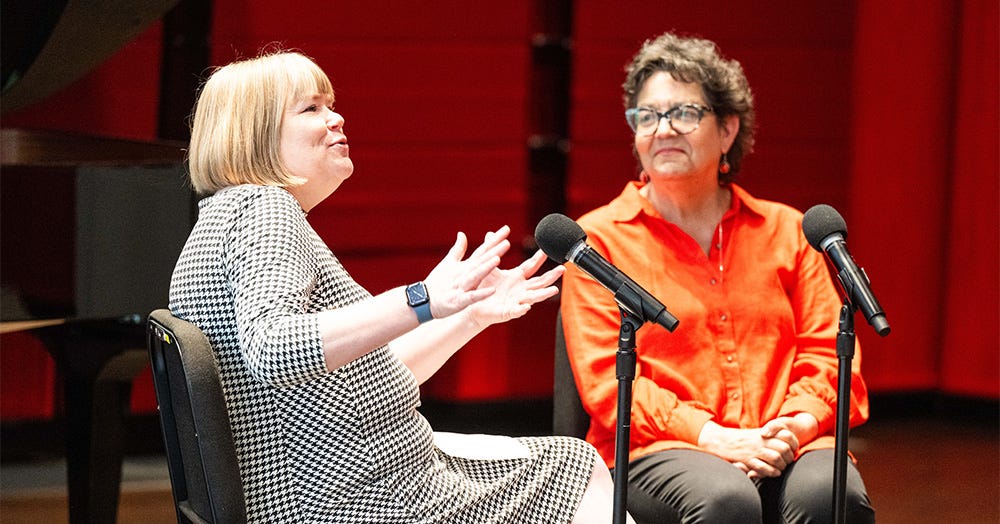
[Caption: I discuss aging with Professor Mercedes Bern-Klug at an Obermann Center event titled, "The Fourth Age of Life: The Challenges of Aging and the Joys of Connecting." Photo credit: Justin Torner, UI Office of Strategic Communication]
I was thrilled to hear that the Csomay Center’s work would be featured in the Iowa Magazine. When the writer, Josh O’Leary, reached out to ask to speak with me for the article, I knew that we would discuss finding meaning and purpose as you age, but we also talked about my experience as a person with Parkinson’s disease. The symptoms and the uncertainty mean that I’m dealing with some of the issues that come with aging before I had planned to. Walking with a cane, prioritizing a single-level living space, giving up driving, and planning for retirement are issues that come with aging. They had just come to me a little earlier.
I hope that you’ll read the article, “How to Age Well: Iowa Experts Share Strategies for Healthy, Purposeful Living.” Josh did an amazing job pulling together the expertise of six faculty associated with the Csomay Center. The advice is backed by science and designed to be practical. Movement, connection, and cognitive health are all important components of optimal aging. I contributed ideas about preparing for retirement in ways that preserve or even increase meaning and purpose. The article also includes part of my personal story and describes how the Csomay Center helps people like me navigate the aging process.
As I read the article, I noticed two things. First, Josh captured my story well, writing honestly about the challenges of Parkinson’s while also highlighting the adjustments I have made. The article reflects my feelings beautifully. Parkinson’s sucks, and most days are OK. But I think it’s also important to talk about the days that aren’t OK. Some days, my jaw tremors and my speech slurs. Some days, I fall right before bed. Some days, anxiety takes control. This is the full picture.
Similarly, the experts’ advice is straightforward—simple, science-backed tips that fit into our daily lives. Effective research translations put science in terms that can be implemented and improve our lives. But just like my experience of Parkinson’s, science is complicated too. For some people, certain types of relationships may be more beneficial than others. Genetic factors may overcome our best efforts to stay cognitively healthy. Everyone’s experience is slightly different. With aging, as with life, we use the evidence, we optimize the best we can, and we accept that optimal aging is a process.
Thanks for giving readers who mentally pronounce words as we read how to sound out “ Csomay” (So-May). Now I just need to acquire your discipline to write a weekly essay!