
Don't Stop Believing
Creating Places that Bring Out Our Best

Does everyone know the opening chords of Journey’s “Don’t Stop Believing,” or is it a Gen X thing? Eight full measures of piano introduction that I recognize in the first two notes. Maybe “recognize” is not the right verb. Those first notes pull me out of conversations, deep thoughts, and even the commotion of public places. My toe taps. My head bounces. I prepare to add my vocals to this story of a small town girl and a city boy.
This has happened many times since the song was released in 1981 - at high school dances, college parties, piano bars, and gatherings around campfires. But never at an academic conference. . . until now.
Last week, I attended the Center for Working Well’s inaugural research conference at Purdue University. The conference was capped at 90 participants, a size that I love. Larger conferences have become more difficult for me to navigate. Small conferences require less walking, fewer large gatherings, and more opportunity to participate in ways that work for me. In addition, I knew that the Director of the Center for Working Well, Professor Allison Gabriel, and the Associate Director of Research and Impact, Professor Kate Zipay, would create a well-planned, developmental experience. They had already signaled this in the pre-conference emails, inviting us to bring doctoral students so they could receive constructive feedback from senior scholars.
Allie and Kate have their own Substack, Paying Attention with Kate and Allie, and they wrote about the conference in a recent post, “A Disputable Purpose.”
We gathered to create a rigorous but deeply human scholarly space where people can think generously, challenge ideas developmentally, and experience a model of academia that feels intellectually alive rather than stiff and performative.
We wanted to rewrite the script: that a life in academia can involve rigorous, serious, scholarly work and involve joy, friendship, laughter, and fun.
And we
f*ckingseriously delivered.
Yes, you did! I enter events like these as both a participant and a qualitative researcher. I’m attentive to details - moments of greeting, moments of gathering, and unscheduled moments. The details had been crafted with intention. Even before I read Allie and Kate’s post about their intentions for the conference, I was describing it using the same language. I left with new research insights, feedback on my own work, and the joy that comes in trying to help colleagues develop their own research. Eminent senior scholars and graduate students alike brought scholarly rigor.
But the rigorous feedback was delivered in a developmental and humane manner. Allie’s opening toast and Kate’s introductory remarks as our cruise director named this goal. The structure of the sessions provided time for it. Purdue faculty and graduate students who helped organize break-out sessions picked up the baton that Kate and Allie handed off and ran with it, creating inclusive spaces filled with learning.
In a talk that capped off Day 1, Professor Sue Ashford spoke honestly about the risks that come with charting your own path through academia, and encouraged us to resist self-doubt. Her advice to know yourself, be yourself, and trust yourself resonated with the graduate students in the room, but it was also a good reminder for me as I consider the shape of the next chapter in my professional life.
We also shared meals, including a lovely dinner at Purdue’s football stadium. (No sign of Purdue Pete, which was honestly OK with me. I find him a little creepy.) I chatted with new and old friends about life, families, hobbies, and future plans. A DJ played music throughout dinner, then moved to the open area with a sundae bar. The cha-cha slide caused a rumble throughout the crowd. Two professors moved to an open area and started the familiar synchronized dance. The DJ tried to encourage a couple of friends and me to leave our sundaes to join in, but he quickly backed off after I stood up with my cane in hand.
But let’s be honest, friends, Parkinson’s disease is not what prevented me from joining in the cha-cha slide. Neither was a concern about how I would be viewed by my academic peers. I was not blessed with rhythm or grace. The cha-cha slide has always been outside my comfort zone. Honestly, I struggle with YMCA and the chicken dance.
But when the opening chords of “Don’t Stop Believing” started playing, I knew my time had come. Without a thought, I joined a circle of people and sang at the top of my lungs. Joy, friendship, laughter, fun.
Researchers draw a distinction between space and place. A space is a three-dimensional container where activities take place. Offices, conference rooms, and banquet halls are spaces. But people can create culture in a space, giving it an identity, meaning, character, and norms. In those situations, a space turns into a place. At Purdue, Allie and Kate created a place where we could bring our whole selves and be honest about challenges, a place where we could learn and experience joy. This place allowed me to share some of my most personal research and sing off-key. What a gift.
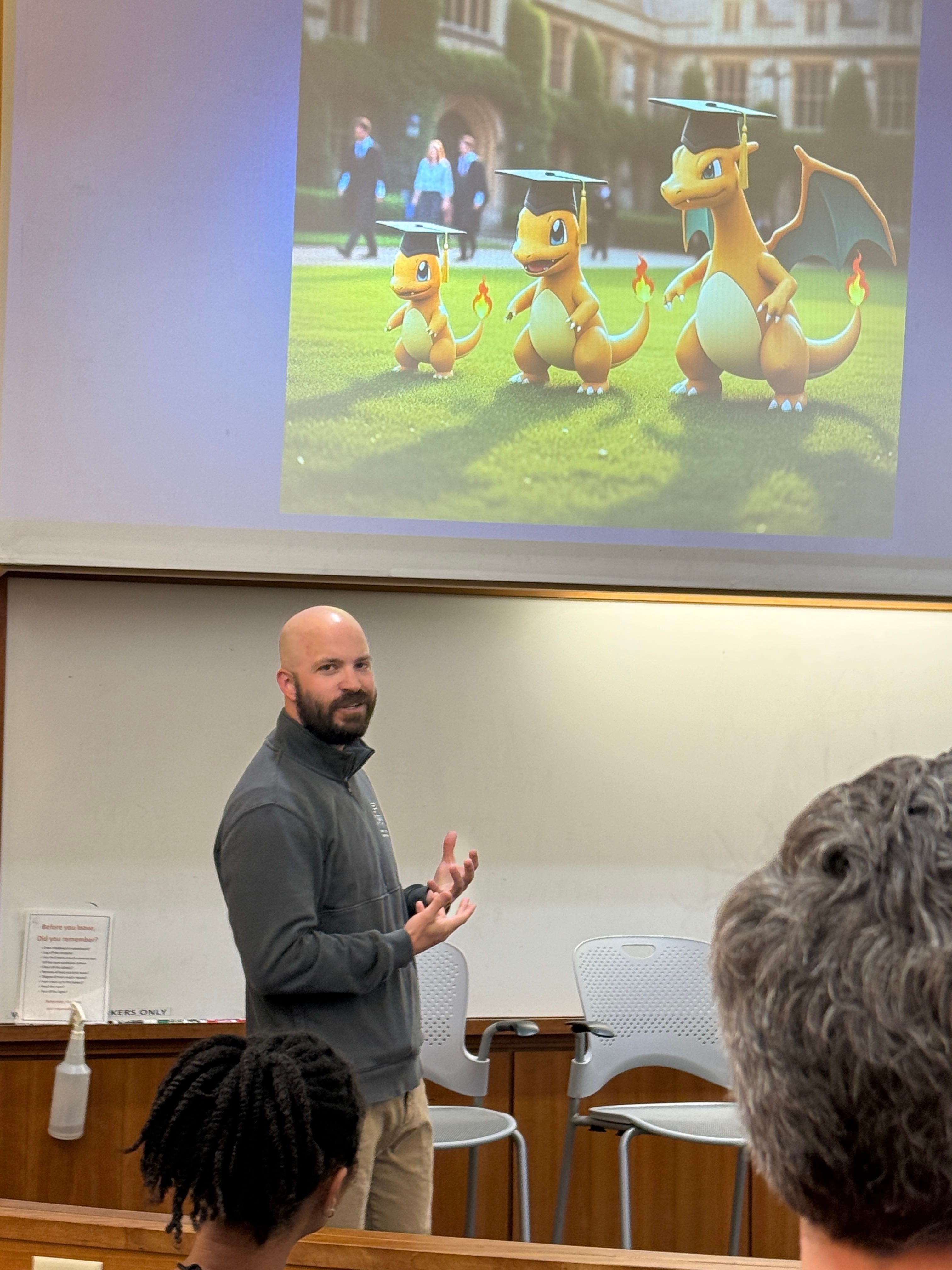
(I was so engaged in the conference that this was one of the few pictures I took. Jordan Nielsen, professor and dad to four of my favorite small humans, took an assist from his kids in developing this visual for a session on the evolution of our field.)
I worry that places like this are becoming rarer. The intention to welcome everyone is not enough. We need to be aware of the needs and fears each person brings to the space. I no longer worry quite so much about whether I’ll be taken seriously as a scholar (although the thought still occasionally enters my mind), but I was thrilled to see each presenter’s research given attention and respect. For me, navigating stairs has become harder than explaining theory, so I felt seen when several of the conference organizers checked in to make sure I could climb onto the raised platform for a panel discussion. After this conference, I renewed my resolve to create places like this. After reading Lyz Lenz’s article about online bullying in Rolling Stone, this resolve became stronger. We all have a responsibility to create places where everyone can be their best selves.
Amy! This was such a gift. I am so glad you were with us in West Lafayette, and I'll always laugh when I think of our sing along moment. Thank you for being with us, and we cannot wait to have you be a standing member of our community.
I hardly have words. Thank you. You are such a valuable part of feeling safe to create these type of places. I will never forget singing in a circle together—it was one of the most uplifting human moments I might ever experience in academia. Grateful for you!