
The Fall Semester
Striving for Impact

We are coming to the end of the fall semester - one more week of classes and then finals week. I have lived my life in semesters for a very long time, and even after I retire, I’m not sure that I will stop. The rhythm has embedded itself in my being. Put me on a desert island with no access to calendars or clocks, and I believe that I could tell you when the end of a semester is on its way.
Living my life in semesters aligns well with my love of planning and reflecting. It is not only on New Year’s Day that I stop to consider the previous year and plan for the next. The beginnings and endings of semesters also provide this opportunity. What has happened? What would I like to happen next? And what does that mean for who I am now?
Fall 2025 marked the beginning of my 22nd year as a college professor and my 19th year at the University of Iowa. It is an interesting time to be on a university campus. In addition to teaching my classes and conducting my research, I’ve had the opportunity to participate in several conversations and initiatives aimed at improving what we do at Iowa. These events have been intentionally planned to invite dialogue - or the free flow of meaning between people. They have not shied away from the complexity of the challenges facing universities and the broader society. And they have been filled with people who have come together with good intentions, people who want to do good work.
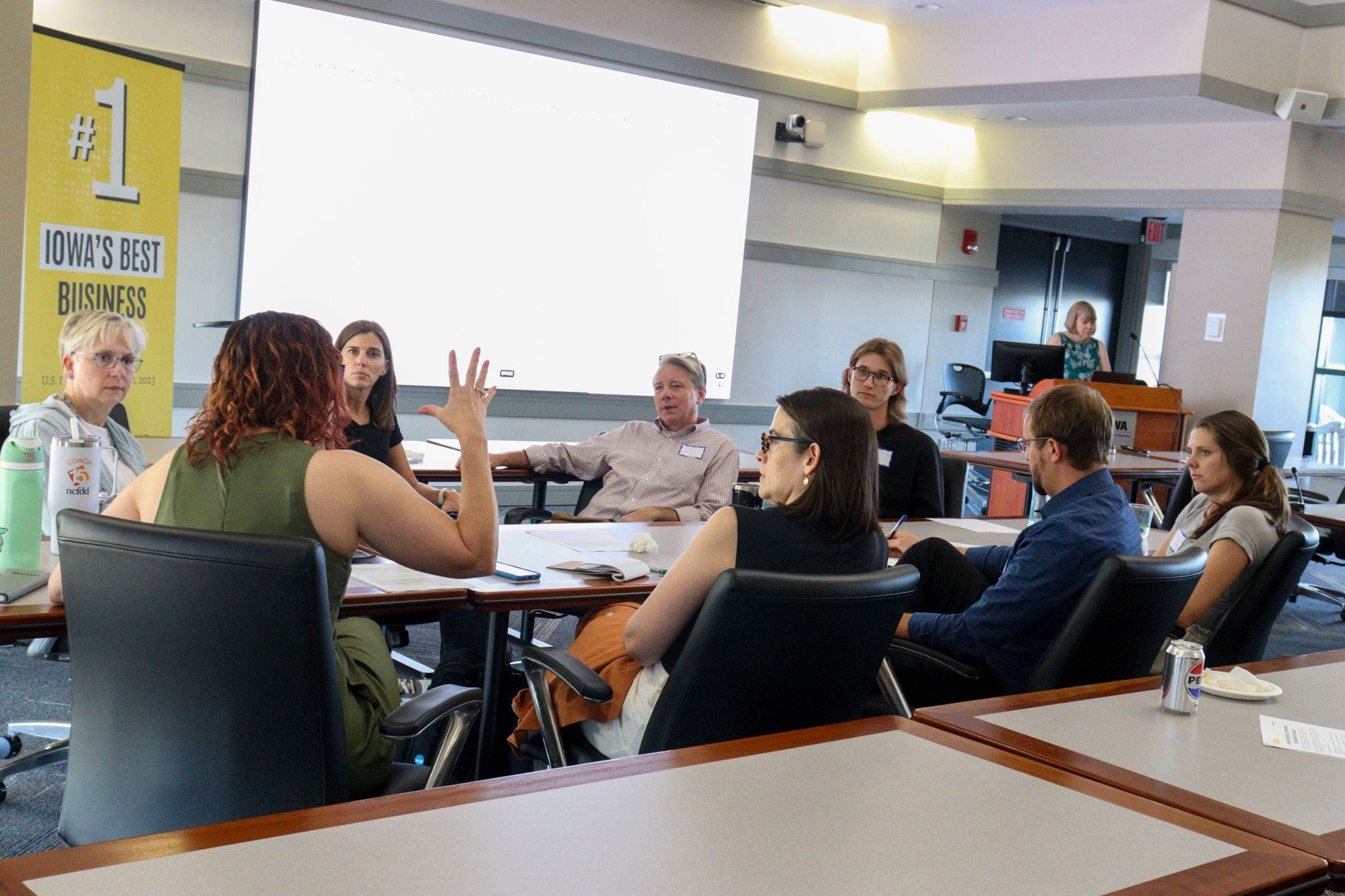
I attended one of these events this past week. The four-hour workshop was hosted by the University of Iowa’s Implementation Science Center as a part of their partnership with the University of New Mexico’s Evidence for Engagement (E2PLUS) program. The goal of the program is to strengthen partnerships between universities and the communities their research is designed to benefit. The Implementation Science Center has two core committees that are working to improve engaged research practices over the next year. The four-hour workshop brought together researchers and community members to provide our perspectives.
At the University of Iowa, one of our strategic priorities is transformative societal impact. We aim to:
Expand the university’s impact on local and regional communities, the state of Iowa, and the world by leveraging its areas of distinction, the resources entrusted to it, and the collective talent of its people.
Even so, systems and processes are not always set up to facilitate community-engaged research. University research is subject to rules and regulations that can slow the process. It takes a long time to build evidence that leads to actionable conclusions. The processes and language used by researchers are often unfamiliar to community partners, and researchers may be unfamiliar with the challenges communities face.
In the E2PLUS workshop, the organizers structured the conversations to build understanding. People shared their past experiences with community-engaged research. The facilitators intentionally paused at this step to encourage perspective-taking rather than arguments or justifications. The genuine gratitude for the first few perspectives encouraged others to speak up as well. As a result, we had a range of perspectives to guide our search for solutions to improve the process. We certainly did not solve every problem, but I walked away from the session with ideas to improve my own community-engaged research. And the core committees gained a wealth of perspectives to guide their ongoing work.
Creating space for dialogue is a goal of mine as faculty director of the Social Impact Community. A few weeks ago, I wrote about the roundtable discussion we hosted, focused on Building Resilient Communities. Building resilient communities requires multiple perspectives. University research has relevant insights, but communities also have deep knowledge developed over generations that reflects an understanding of local challenges and resources.
Transformative societal impact requires creating spaces where knowledge is not only shared, but also combined. One of the first research projects I worked on in graduate school, with Sara Rynes and Ken Brown, provided evidence that academic research is often not used by practitioners. From the healthcare side of campus, I’ve learned that on average, it takes 17 years for evidence-based interventions and healthcare practices borne out of research to be adopted in hospital and community settings. Sara Rynes and her collaborator, Jean Bartunek, have developed strategies to change how we conduct and communicate research so that it is more likely to have an impact on the world. Our colleagues in Iowa’s Implementation Science Center are doing similar work to increase the implementation of healthcare findings.
Transformative societal impact is what I refer to in my leadership classes as a BHAG (big hairy audacious goal), but we are not taking our eye off the ball. People at the University of Iowa and other universities around the world are working hard to produce impactful research. Community members are coming to the table to share their perspectives and knowledge, and to shape the research with us. Transformative societal impact seems more important now than ever. And despite the conversations about “What is wrong with universities?”, which have seemed especially prevalent this year, my experiences make me believe there is even more to say about what’s right with universities.
Amy, you have done a wonderful job of furthering the mission to bring research findings into practice! ❤️. Thank you for your important work!
Ann, your reflections on savoring the completion of a semester struck a chord with me. I measure my years in semesters, and each term feels like finishing a major project—one that deserves celebration. When grades are submitted and the last lecture fades, I pause, much like you, to reflect on the work and the learning—mine and my students’. And then, my ritual: a perfectly grilled ribeye steak.
The assertions that our university needs outside pressure to become more relevant often feel politically motivated. That’s why I’m heartened by the workshop you described—real dialogue and collaboration aimed at meaningful impact.