
The Syllabus
A Map for Learning or a Gateway to Discovery

Tomorrow, I will begin my 22nd year as a professor. When I finished my undergraduate degree, I never thought I would stay in the same job for more than a few years. I like learning new things. My top strength on the Gallup StrengthsFinder is input (the desire to take in and analyze information). One of my core values is curiosity. In my early years, I was a babysitter, pizza maker, tour guide, math tutor, and bookstore clerk. After undergrad, I worked for two years as a public accountant and three years as an internal auditor. I was always thinking about what might be next.
But as a professor, learning new things is the job, and this is why I’ve stayed. Part of my job is to do research. I get to ask questions and then collect data to answer them. How do people find a calling? How can work relationships support your productivity and your well-being? How do organizations adapt to changes in government and society? How do people make sense of degenerative diseases in the context of work? A single project can take years, and I work on multiple projects at a time. In addition to my joy in learning new things and creating new knowledge, each new project brings me face-to-face with things that I do not know. Learning is a journey, and the journey begins with not knowing.
This experience of not knowing is part of what I bring into the classroom with me. Throughout my career, I have taught undergraduate, MBA, and Ph.D. courses. For each class, I put together a syllabus, a map for our learning journey. How will we get from not knowing to knowing? Don’t worry. We’ve got a map.
Although I’ve written well over 50 syllabi in my career, I’d never investigated the history of the word until now. Syllabus is made up of the Greek roots “syn,” which means “with,” and “lambanein,” which means “something received or taken,” perhaps even “an argument taken for granted.”
I spend a lot of time crafting my syllabi, using my expertise to select objectives, readings, activities, and assignments that will provide students with the knowledge and critical thinking skills that they need. When I take a class, I find a syllabus comforting. How does one learn about leadership or motivation or innovation? These topics are vast. Any literature review or Google search returns thousands of entries. When I create a syllabus, I consider myself a curator, selecting evidence that can be trusted. I try to help students create a mental map of the subject, a framework on which they can hang past and future insights like ornaments on a Christmas tree.
On the first day of each class I teach, I explain to students why this syllabus is something that they should receive, why our objectives are worthwhile, and why they can trust me as a mapmaker and guide. But what I don’t want is for the syllabus to be an argument taken for granted. It is there as a beginning, and given that students are taking multiple classes along with work and life, absorbing everything that I’ve curated in the course of a semester may be a stretch goal. But ultimately, I hope that the syllabus is only the beginning, or as I say to my MBA students, “one step in your leadership development journey.”
My favorite moments of learning don’t come from following a syllabus. They take advantage of serendipity. I love opening the New York Times or Maria Popova’s beautiful newsletter, The Marginalian, on Sunday morning and getting curious about a topic. I click on source links, jot ideas in my bullet journal, and lose myself down rabbit holes. This is the kind of learning I hope to spark in my students. I prefer to think of my syllabus as a gateway to discovery rather than an argument taken for granted.
And perhaps this is why I was so delighted to learn that the word syllabus may not be made up of the Greek roots “syn” and “lambanein,” negating the interpretation of an argument taken for granted. Instead, according to the Oxford English Dictionary, the word syllabus may come from an error in transcribing the Greek word “sittybos,” which can mean “table of contents,” but also “skin, leather, leather straps, fringes,” and “cauldron.”
First, let’s just sit for a minute with the possibility that the word syllabus may have some from a transcription error. It’s a nice reminder that even something created by experts shouldn’t be taken for granted. Learning involves errors, and part of my goal in developing a map for learning is to normalize those errors and convince students that they are the key to learning. Even the word syllabus may have come from an error.
I also will forevermore think of my syllabus as a cauldron, an opportunity to mix evidence and ideas and activities and reflection, a plan to allow them to boil slowly over a low flame for the semester. There is not a strict recipe for learning. Each semester, I change the ingredients slightly. (I learn from my mistakes too.) Each student adds their own ingredients, and with any luck, we end up somewhere different than we started. We may have taken some side roads, and we may still be miles from our destination, but by December, we will have made progress, and in January, we will begin the journey again.
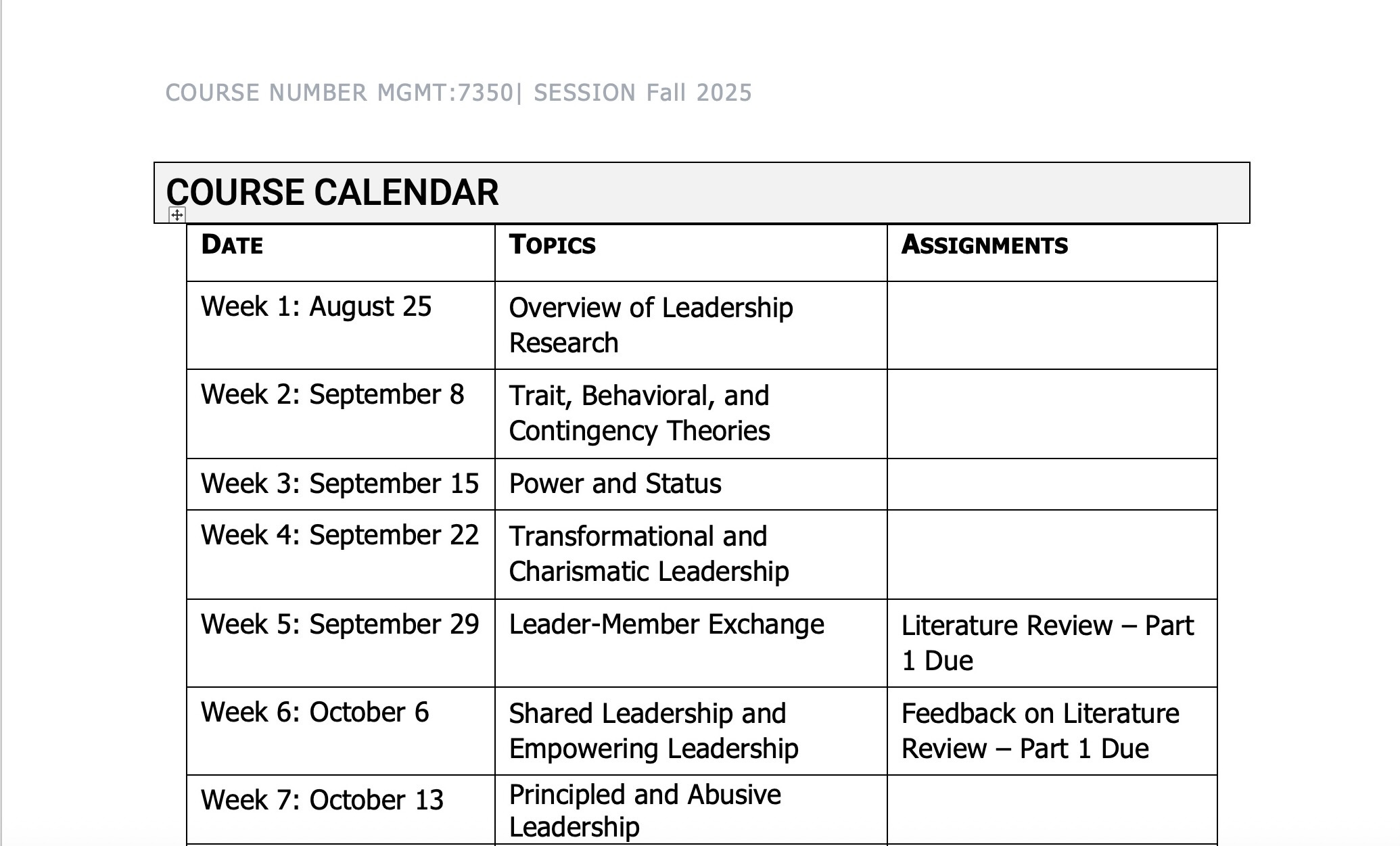
People complain that their college degree didn’t prepare them for the (mind numbing) number of meeting required in their career, so I put together a syllabus for Intro to Meetings, a required freshman class. It includes a weekly calendar.
Intro to Meetings (MGMT 101) - Required Freshman Seminar
University Mission Statement (as it Relates to This Course): To thoroughly prepare students for the soul-crushing realities of the modern professional world, one excruciatingly pointless meeting at a time.
Course Description: Welcome, bright-eyed freshmen, to the cornerstone of your future success (and profound existential dread). This mandatory 16-week immersion program will equip you with the essential skills to not only survive but appear engaged in the endless parade of meetings that will define your career. Prepare to master the art of nodding thoughtfully, contributing absolutely nothing of substance, and feigning enthusiasm for topics that would bore a rock.
https://docs.google.com/document/d/13cBSE3xibHYCeL2wWRIPHcv_Xaq0CvnDv6VAmWGfM2s/edit?usp=drivesdk
Thank you for your thoughtful reflection on preparing syllabi. As an ethicist who has been teaching for more than a decade, I take an inclusive and dialogical approach to pedagogy. But I am preparing to teach my first Constitutional Law class in a law school and reading two leading books on the best way to teach law students. I entered academia as an attorney and adjunct professor before pursuing a Ph.D. with a focus on ethics. So, your words about are especially helpful as I prepare my syllabus for this class. I really appreciate your perspective!