
Winter Solstice
From Letting Go to Receptivity

This year, we hosted the third annual winter solstice breakfast on the final morning of finals week. This is not a fancy event. We buy pastries and fruit. Mike makes an egg-y bake, and I make a few extra pots of coffee. Colleagues and students drop in to decompress at the end of a long semester and celebrate the return of the light.
Perhaps it was because I have more energy in the mornings, or perhaps it was because Mike, Ben, and Matt were here to help with hosting, but I thoroughly enjoyed this event. No one blinked an eye when I said, “Help yourself. Holler if you need something.” No one judged (at least out loud) when they grabbed a napkin and a plate left over from previous parties (Monsters Inc, Bluey, Lilo and Stitch). This is an easy crowd.
I smiled each time someone new came through the front door. It’s hard to beat the feeling of a student letting herself in the door with an “I’m here” pose, wearing a fuzzy sweatshirt with “Celebrate” written across the front. I laughed as Matt explained to an accounting professor that he hadn’t suffered through his first semester in the business analytics Ph.D. program. Rather, it had been challenging but enjoyable. I worried that our PhD students may be dissatisfied with their teaching assignments after hearing Ben’s stories about teaching billiards and bowling. And the pastries fueled me through a final push of grading.
Winter solstice marks the end of the Celtic season of “letting go.” Theoretically, I like to think about letting go of things (except books) and obligations. I imagine a minimal, focused future self. In practice, I’m less successful. Especially when I don’t have much time to pause, I begin to live among stacks - stacks of mail, books, items on my to do list. I hear Dory’s voice in my head. “Just keep swimming,” she says. This is a skill that has served me well.
When I thought about quitting the PhD program and becoming an Episcopal priest, I just kept swimming.
When I used my rational brain and still failed to figure out why my kids refused to get in their car seats or play nicely together, I just kept swimming. (And now it is Annie who ignores my advice to “Live and let live,” and instead lunges to chase squirrels, bunnies, and deer.)
When I argued with my body (and a friend) when they told me that teaching three classes in one semester might be too much, I just kept swimming.
But winter solstice (and the end of the semester) marks a pause, a time when I can sort through the stacks, re-evaluate priorities, delete the random screenshots from my phone, and reassess priorities. I’ve read Marie Kondo. I can let go of things that don’t spark joy. It’s harder to let go of those things that do spark joy, but may just not fit anymore.
Of course, as soon as the piles have been sorted, they will reappear. That’s why the Celtic season that is on the other side of the winter solstice is so important. We move from a season of “letting go” to a season of “receptivity.” From the winter solstice to Imbolc (February 1), the season of “receptivity” invites a pause, quiet moments, and discernment. Instead of making New Year’s resolutions, perhaps I should use January as a time of receptivity.
Can I do it? I’ve already set a reading goal for 2026 (more about that next week). I have a new bullet journal just waiting for 2026 goals. I am, and have always been, a planner. But just like we added salsa to the egg-y bake at solstice breakfast to bring in a new flavor, perhaps I can sprinkle in a little receptivity, holding plans loosely, and letting the new year come to me.
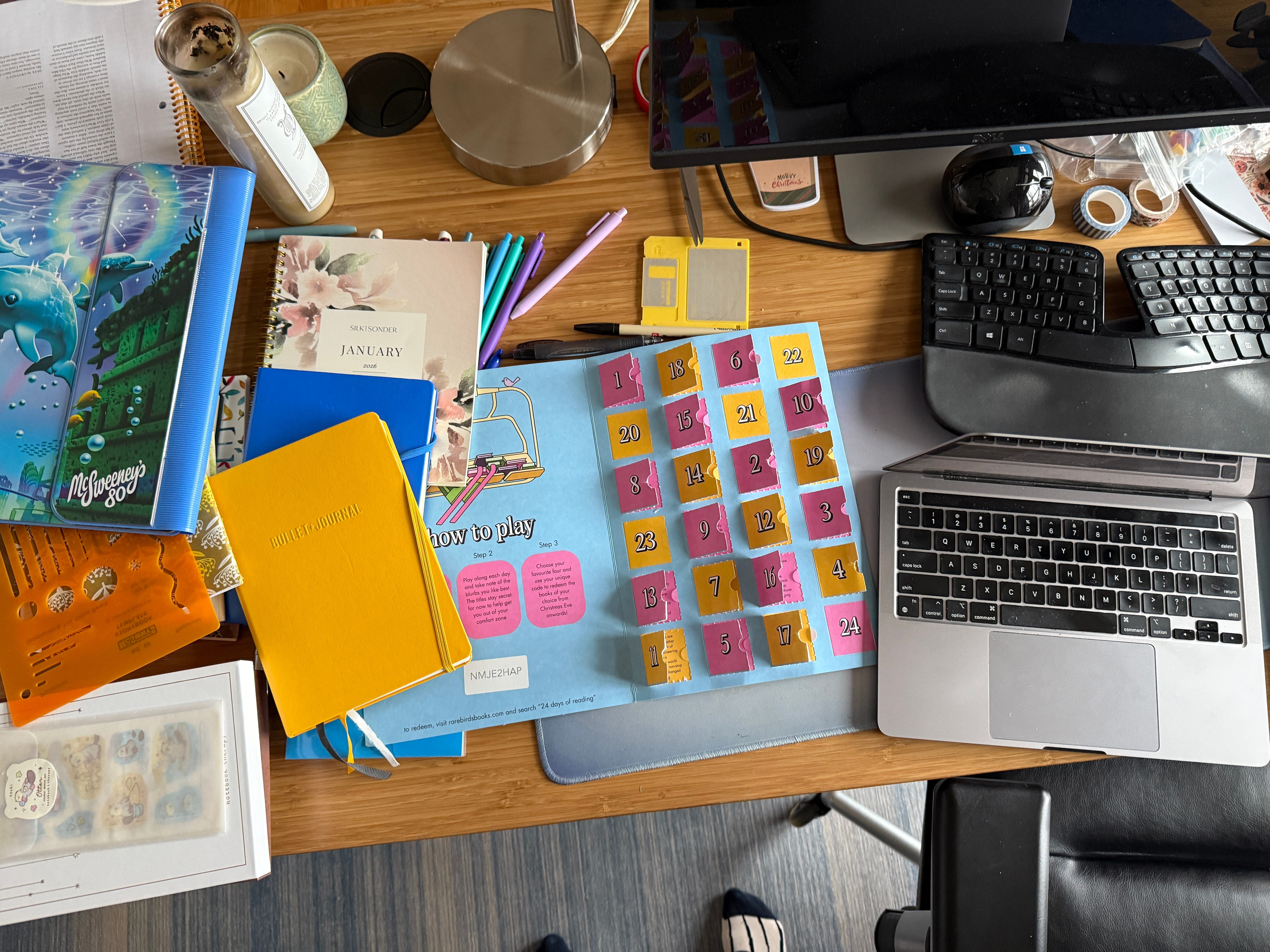
(Picture includes my Advent calendar, which has a short description of a book for each day. After Christmas, Rare Birds Books sends me the books that match the four descriptions I’m most intrigued by. What could be better than that?)
Thank you for the work "receptivity." Taking time to pause for discernment is a step I sometimes miss as I "just keep swimming."