
Writerly Moves
Appreciation for the Iowa Summer Writing Festival

I started this Substack after taking a class at the Iowa Summer Writing Festival last summer. What was it about that class that made me believe that I could write a weekly essay and put it out into the world? I give a lot of credit to our teacher, Amanda Montei. She shared examples of personal essays that gave me goosebumps and helped us understand how each piece was crafted. We wrote a lot. Even though we were only together for two days, the prompts that Amanda gave us caused words to fly around the conference room in MacBride Hall, pouring out of the writers gathered there. Although my love of a well-chosen word and a beautifully crafted sentence developed much earlier in life, Amanda’s class gave me the courage to bring my own words to life.
This summer, I continued to hone my craft at the Iowa Summer Writing Festival. In a class on memoir writing, I learned what our teacher, Suzanne Scanlon, termed Writerly Moves. I’ve never had moves. I am uncoordinated on the dance floor and in real life. But Suzanne made Writerly Moves accessible. Just look at how Vivian Gornick uses time in the first pages of Fierce Attachments, taking us back to when she was eight years old, but writing in present tense to give the scene immediacy. See how Sarah M. Broom draws us a map with words, allowing us to approach The Yellow House alongside her. She talks directly to us, addressing us as “you,” bringing us into the scene. And in Autobiography of a Face, Lucy Grealy writes an emblematic scene so beautiful that I will never forget her pony parties, where she brought ponies to children’s backyard birthday parties and turned her face to avoid being captured in their pictures.
Then it was our turn to try out these Writerly Moves. We were a bit awkward at first, taking tentative, vulnerable steps, but gradually we gained confidence. We wrote about some of the most impactful moments in our lives - moments when we fell in love and moments when we fell apart, moments when we doubted and moments when we believed, moments that are so much a part of who we are that it is a struggle to capture them in two dimensions. But we did. We put pen to paper, and we used our Writerly Moves to honor those moments, to share them in a way that allowed others to not only hear them, but to crawl inside the scene with us so that we were suddenly less alone. Putting these moments into words that captured them with precision and care helped me understand myself better because these moments have shaped me.
We read our work aloud so many times that we stopped feeling self-conscious. From time to time, after a particular elegant Writerly Move, you could hear soft murmurs of appreciation, similar to those that follow the first bite of an exquisitely prepared meal. As we gave each other feedback, we’d call out the Writerly Moves by name. “I loved how you started that scene in media res” (in the middle). “I felt like I was in that house with you. The details you shared captured it perfectly.” “Your use of direct address pulled me in.” In this way, everyone in the class - those who were decades younger and decades older than me, those who came from a similar background and those who were forged by different tribulations, those who had traveled across the country and those who lived right down the street - were responsible for once again convincing me that I could be a writer. Maybe I’ll even write a book one day.
These experiences have made me think about what a gift it is to have a space that is designed to hold you while you are trying new things and taking risks. One reason that I started going to the Iowa Summer Writing Festival was to be a beginner again. I wanted to empathize with my own students as they are learning new things. As a teacher myself, I noticed how the teachers at the Iowa Summer Writing Festival subtly shaped the culture in the classroom, making learning and discovery a joyful process.
But the experience went far beyond the classroom. Iowa Summer Writing Festival Director Amy Margolis and her team, Becca Klaver and Alisa Weinstein, intentionally created a space where we could create. Each session began with an orientation designed to put everyone at ease. Each session included an open mic night, where for three minutes, being a writer transformed from living inside your head to being in the spotlight and hearing applause. The Eleventh Hour Lecture series, a series of 11:00 am craft talks, were shared with Iowa City residents who could attend these insightful presentations free of charge. The Iowa Summer Writing Festival is so much more than the classes. It is an immersion that brings forth storytellers and their stories. I am already on record as a lover of stories, that potent form of magic and protest, of wonder and delight, of hard truths and hard-won truths and shared truths.
This week, the University of Iowa announced that the Iowa Summer Writing Festival and the Iowa Youth Writing Program will close as of December 31, 2025 for financial reasons. I do not know how this decision was made. Many have written openly about the negative implications of this decision in the past few days. (I especially recommend Jenny Rowe’s post, Ars Longa Vita Brevis Est.) The deep sense of loss that I felt on hearing the news is a testament to the impact this program has had on me, an impact that I hope I’m conveying here. But my feelings were echoed on social media by students and teachers alike. The festival started in 1987, its impact spanning decades.
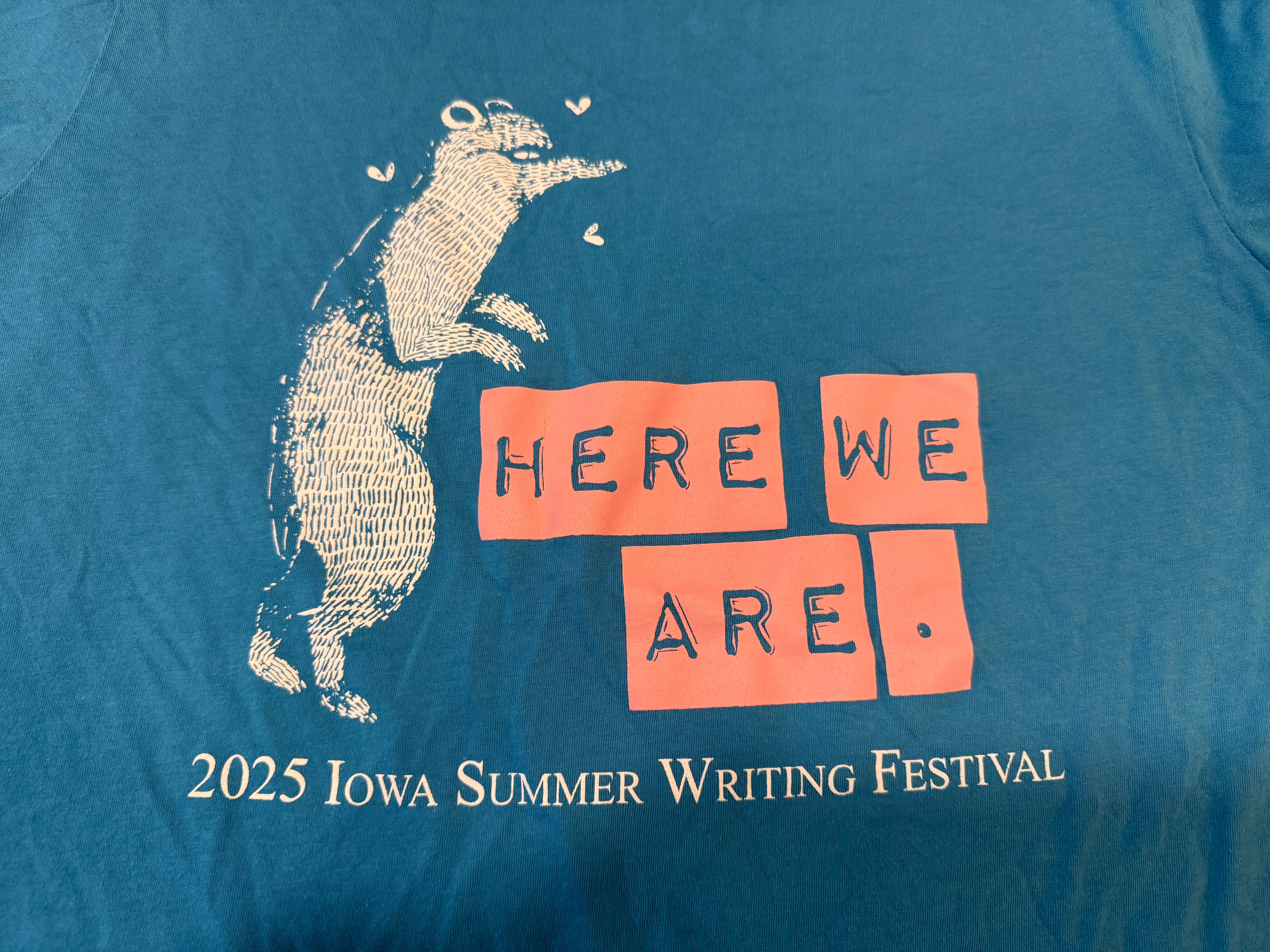
I’ve tried to understand my grief upon hearing this news. Of course, it is partly selfish. I don’t think that it is overreacting to mourn the loss of a space that has been instrumental in my identity development. Writing helps me make sense of my Parkinson’s diagnosis and share my experience with others going through their own transitions. Other attendees have their own stories. The festival is clearly something special, an inclusive experience that has changed the lives of so many.
But I also feel this loss because the festival exemplifies what I believe is one of the promises of public universities (promises that we need to publicize now more than ever). The University of Iowa is known as the writing university, primarily because of the Iowa Writers’ Workshop. We were the first university in the nation to award a Master’s of Fine Arts degree, and the workshop is one of the best, accepting only a small percentage of those who apply. But the Iowa Summer Writing Festival made this rarefied expertise available to those of us who will never have the opportunity to be students in the Iowa Writers’ Workshop. We walked down streets in which literature is celebrated and became a smart part of this amazing tradition.
If my mom were still with us, I would have encouraged her to sign up for a class. I always knew she had a book in her, and I often feel her presence as I sit in classes trying to capture her essence in words. I don’t worry that she would have felt out of place. I think that, like me, she would have felt that she had found her people. I’m sad that I won’t have the chance to continue to learn and develop as a writer at the Iowa Summer Writing Festival, but I’m even sadder that we’ve lost a chance to democratize the writing university, to invite everyone inside, if only for a few days. Everyone has a story, and for a while, everyone had a place to bring their story to life.
Amy this sounds amazing - I was reading it so happy you got to do this and so jealous (to be honest!) because it sounds perfect - and then I got to the terrible part that they are closing it down. Just terrible. I am sorry.
This really captures what makes the Festival so special, not just the classes, but the community, the encouragement, and the sense that everyone's story matters. It's heartbreaking to think of that being lost. Thank you for putting these feelings into words🙏🏽🫡.